Directed by John Vreeke
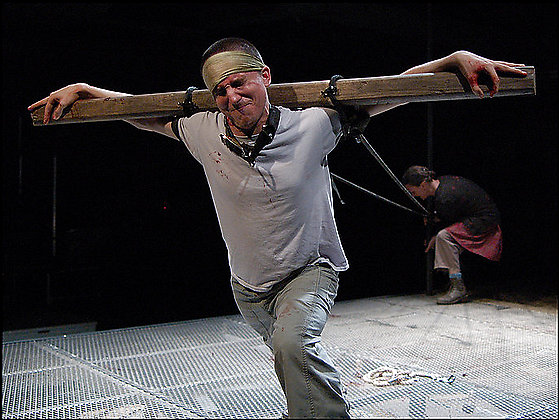


Striking a Blow For Forgiveness
With 'The Monument,' Playwright Wrestled With Some Brutal Truths
Tuesday, June 13, 2006; Page C05
"The Monument," Canadian dramatist Colleen Wagner's play about war and ethnic blood feuds, roils with rage, grief and a stylized brutality. Her script doesn't specify the time or place, but the Theater Alliance production, at the H Street Playhouse through Sunday, echoes Bosnia during the 1990s.
John Vreeke, who directed the production, says the 85-minute piece is a blank-verse poem. "The rhythms are defined by the placement of the text on the page. It reads like a contemporary Greek tragedy," he says.
Alexander Strain plays a war criminal
freed and then shackled by a woman whose daughter he may have slain. (By Colin Hovde -- Theater Alliance)
|
In it, Mejra (played by Jennifer Mendenhall), the mother of a young woman who is one of many that a soldier may have raped and killed while "following orders," gets the soldier released just minutes before he is to be executed. She then forces the shackled man, Stetko (Alexander Strain), into the forest with her to search for the remains of his victims.
"I feel like it's all about essences," Mendenhall says. "It could be Bosnia, it could be Rwanda, it could be Auschwitz, it could be anywhere that horrible things are done, and then it's like, here are the common denominators."
Wagner, from her home in New Brunswick, says she wrote "The Monument" after an extended sojourn in Southeast Asia. "When I came back in 1993, there were 43 bloody civil wars going on in the world . . . and the former Yugoslavia was one of them, but so was Rwanda, Somalia, endless wars in Africa and, of course, East Timor," she says.
She had been commissioned to write a play about the exploration of the Canadian north, but the characters in "The Monument" kept butting in, first in the form of Stetko's opening monologue, describing his atrocities with bravado, even as his execution is imminent. "I was pretty shocked by this voice, this character that I was hearing, but I thought, well, interesting exercise," Wagner says. "These characters forced themselves upon me. They were there and I simply had to write it. . . . I wrote it actually in about three weeks, then spent a year trying to do that last scene."
That scene hints at the possibility of forgiveness and reconciliation. It comes after nearly 90 minutes of recriminations and violence.
Mejra slaps Stetko across the face many times in a kind of vengeance ballet and later erupts in an even greater fury. But in the intimate space of the H Street Playhouse, Vreeke says he decided against choreographing "realistic" blows in favor of stylization. "She's swinging her hands, she's making a grunting sound like she's slapping, he's making a grunting sound like he's being slapped. You can see what's going on in his face. . . . You couldn't see that if we tried to make it real."
The non-naturalistic approach to the violence was intended to "remove people from trying to analyze it as being real or fake, and expose what it really is, which is this grotesque and horrific activity," Strain says.
It was hard, Wagner says, to portray the mother as anything other than fully justified in her actions, but she opted for a more difficult conclusion. "I wanted her to be a little more saintly. But in truth, she couldn't be, and in truth, we're not. And what I discovered, really, is only by coming to that place, where they can both look at each other and realize, yes, I am no different than you, my hands are as bloodied as yours" can they ask, "where can we go?"
A MONUMENTAL ACHIEVEMENT
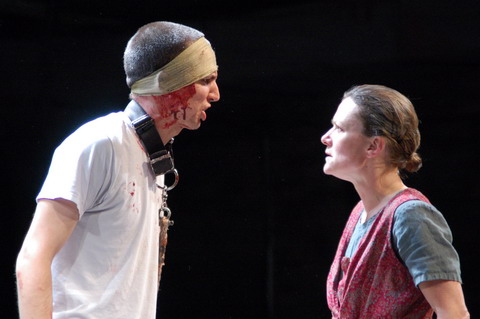
Beginning with Alexander Strain’s opening lines it is obvious that Colleen Wagner’s The Monument, mounted at H Street Playhouse by Theater Alliance, is a play that describes horrible pain and suffering. This production draws you in to its tragic narrative and by plays end you find yourself left with many difficult questions to ponder. Not an evening of light entertainment, one should be prepared for something far more demanding in order to do the production justice. John Vreeke’s firm direction shines through the dark script, bringing out the human frailty that hides beneath the terror of war.
The plot is simple, during an unnamed genocide Alexander Strain
(Stetko) has brutally murdered and raped twenty two young women and
buried them where their families could not mourn their deaths.
Convicted of war crimes, he awaits his execution strapped to a
gurney. He describes the gory details of his crimes as he twists
against the restraints. Jennifer Mendenhall (Mejra), a frail woman
dressed in torn clothing steps from the audience with an offer he
cannot refuse. Stetko is spared the gallows and agrees to follow her
every direction for the rest of his life. What follows is a journey for
both characters, one in which they discover unknown things about
themselves and in addition they discover truths they wish could
remain buried beneath the scorched earth of war. In the end we
have feelings for both of them, both compassion and disdain and a
lingering feeling that the terrors witnessed by these
two people will be subjected on many more victims until people
truly
learn to communicate with each other.
Alexander Strain shows great range in a role that is different
from any we have seen him in previously. His character is weak and
filled with self loathing but has a violent evil side. Strain
seems to grow in the role as the play progresses – at times his
performance becomes so horribly real that his glare is terrifying.
Jennifer Mendenhall’s Mejra is incredibly complex but she handles it
with seemed ease. This character holds inside her heavy burdens
that
threaten to drag her into the earth that holds not only her daughter
but
the thousands of nameless victims of terror and genocide. Ms.
Mendenhall’s
character becomes larger than life as the conclusion nears and she is
able
to show us both sides of this woman who has mixed feelings about the
monster
who murdered her child.
The set at H Street for this play was a dark, dirty stage that well
represented the aftermath of war, the eye-sore of human inventions.
Various articles of tattered female clothing are tacked to the rear
wall of the stage as if to honor all that remains of their short lives.
In an interview with DCTR before the show Ms. Mendenhall expressed the importance of this and other plays that force us to reason through difficult questions and situations. The passion she brings to this play is significant and it is my feeling that this is not a show to miss. The Monument and its lessons are well worth your time.