
 "BOOM"
by Peter Sinn Nachtrieb * directed by John Vreeke November 3 – November 30, 2008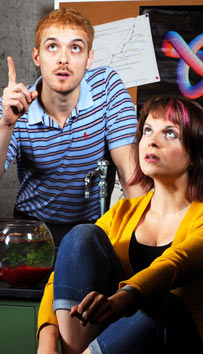 “Sex to change the course of the world…”
A grad student’s personal ad
lures a randy journalism coed to his subterranean lab, where he studies
fish sleep cycles for signs of the apocalypse. Will their “intensely
significant coupling” lead to another big bang, or is mankind’s fate in
the hands of someone watching from outside the fishbowl? “Sex to change the course of the world…”
A grad student’s personal ad
lures a randy journalism coed to his subterranean lab, where he studies
fish sleep cycles for signs of the apocalypse. Will their “intensely
significant coupling” lead to another big bang, or is mankind’s fate in
the hands of someone watching from outside the fishbowl?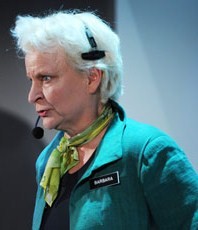 Can the apocalypse be the ultimate
aphrodisiac? It certainly ups the
ante when a marine biology grad student attempts a hook up with a
journalism major in his subterranean lab. Their simple online
connection quickly moves beyond casual sex - into the realms of
ontogeny, phylogeny, evolution and extinction! In this provocative
sci-fi fantasy, the future of humanity hangs in the balance as
irreverent young playwright Peter Sinn Nachtrieb asks: do we control
our own fate or is someone else pulling the levers?
Aubrey Deeker and Kimberly Gilbert BOOM features Woolly Mammoth company members Kimberly Gilbert and Sarah Marshall, with Aubrey Deeker REVIEWS:  The Elements Unite to Create Woolly's 'Boom' Production Crackles With Quirky Writing, Earnest Characters By
Nelson Pressley
Special to The Washington Post Wednesday, November 12, 2008; Page C04 Woolly Mammoth Theatre Company must have fun sorting through the latest batch of weird, because they've unearthed a grandly wacked-out apocalypse fantasy in Peter Sinn Nachtrieb's "Boom." This is boy-meets-girl stuff that's not just twisted, but gleefully torqued.
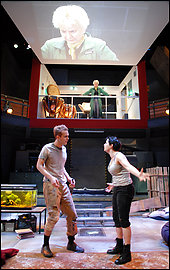
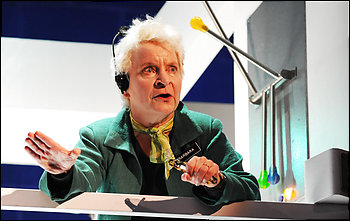
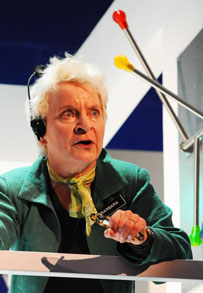
Oh, and there's a crazy lady on a balcony, who's overhead pulling levers and occasionally talking to us like a "Twilight Zone" version of the Stage Manager in "Our Town." That is enough to send director John Vreeke and his inspired team heavenward, for the designers and the three spot-on performers seem to catch every pensive and hilarious breeze that blows through Nachtrieb's science-fictiony script. That the production is thinking big is clear even in the pre-show music, which gets grins just by pumping in such classical chestnuts as the "William Tell" Overture and the "Anvil Chorus" from "Il Trovatore." (Beethoven and Samuel Barber get serious shout-outs as the story unfolds; whether this puckish musical upscaling of emotions is Vreeke's or Nachtrieb's, it works.) Designer Thomas Kamm makes beautiful use of the Woolly space,
provocatively angling a video screen over a stage that thrusts well
into the audience. That screen gives us close-ups of Barbara, the
docent whose connection to the not-quite-romantic story she's
supervising gets more interesting all the time -- and not just because
of Sarah Marshall's delectable, characteristically intense oddball turn
in the role. At first, Barbara seems like an unwelcome interruption of the hip screwball dialogue that Nachtrieb pens for Jules and Jo. Their "meet cute" does indeed fall on a globally cataclysmic day that, um, complicates their hookup. (Plus in the ad, he didn't mention that he's gay.) The script's high-flying banter is glib, ironic, profane -- pure catnip for Aubrey Deeker and Kimberly Gilbert, two of the busiest and most resourceful young actors in town. Deeker is ideally cast as the peculiar scientist who's potentially creepy but probably okay. His Jules is painfully earnest; the character's wooing is inept but thoughtful, in an end-of-days kind of way. Deeker is terrific with everything from Jules's iffy kissing to the academic vindication he feels when his disaster prediction comes true. His performance is tender and funny, with just the right streak of bizarre.
It's a happy fit all around, one of those charmed evenings when a company finds a play that's squarely in its wheelhouse and gets just the right people involved. The writing is terribly smart -- Nachtrieb knows his science well enough to goof off skillfully while retaining a healthy sense of wonder -- and Vreeke and company match that standard with savvy of their own. Boom, indeed. Boom:
Blow Up the Outside World
Sparks
fly—really—when a fish researcher and a journalist wait out the
apocalypse.
Review by Trey Graham Posted: November 12, 2008 It will tell you something about Woolly Mammoth’s Boom, perhaps, that my first thought upon seeing the set was: “Kettle drums? Really?” It will tell you a bit more, I hope, if I say that it’s the serenely loopy Sarah Marshall who strolls on to play them, as well as a large gong, and once or twice a triangle, as the action commences. 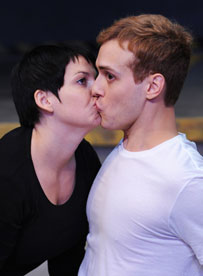 And that despite Marshall’s constant, cacophonous presence, Peter Sinn Nachtrieb’s pixilated post-apocalyptic comedy—or is it a soaring, wonder-filled creation myth?—centers mostly on a queer virgin marine biologist and a journeywoman journalist with anger-management issues and an unfortunate propensity to die (though only briefly) at the oddest moments. A more unlikely Adam and Eve I’ve yet to meet. So this is what folks mean, you’ll be thinking ’round about now, when they talk about “a Woolly play?” Well, yes, despite the conspicuous absence of incest—or indeed sex of any kind aside from the implied, or the hoped-for, or the piscine. There’s no murder, either, though the entire planet does eventually get wiped out—which as you might imagine inspires a certain amount of panicky introspection among our lone-survivor heroes. So yes, Boom—an uproariously funny study of two misfits stranded at world’s end, wondering what on earth selected them for singularity and whether they can possibly measure up—is every inch a Woolly play: It’s literate, coarse, thoughtful, sweet, scabrously inappropriate, wracked by existential anxiety, and wonderfully humane. Actually it’s mostly just wonderful: I haven’t had quite so much fun at the theater, or been quite so consistently surprised, in who knows when. Nachtrieb’s script employs something like the familiar rhythms of situation comedy, but nearly every setup-punch-line combination comes with a kind of topspin that keeps things feeling fresh. John Vreeke’s staging attends carefully to those rhythms, tightening the pace when the playwright is pouring on the funny and stepping back to let the richer moments breathe. 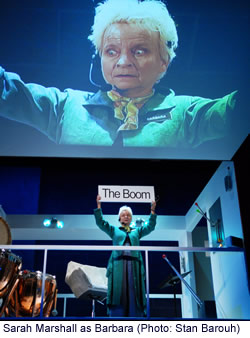 And the
cast—Marshall as a kind of ringmaster-cum-narrator, pulling levers and
throwing switches overhead, plus Aubrey Deeker as the researcher and
Kimberly Gilbert as the would-be magazine writer—has found the story’s
sweet spot, which lies precisely at the intersection of madcap and
heartfelt. Not much that happens in Boom would make the slightest sense
in what we think of as the real world, but this crew creates a space in
which it’s not just OK to laugh along as the absurdities pile up but
essential to chuck the skepticism and buy right on in. Which means that
when things go wrong (and oh, do they go wrong), it actually stings a
bit. And the
cast—Marshall as a kind of ringmaster-cum-narrator, pulling levers and
throwing switches overhead, plus Aubrey Deeker as the researcher and
Kimberly Gilbert as the would-be magazine writer—has found the story’s
sweet spot, which lies precisely at the intersection of madcap and
heartfelt. Not much that happens in Boom would make the slightest sense
in what we think of as the real world, but this crew creates a space in
which it’s not just OK to laugh along as the absurdities pile up but
essential to chuck the skepticism and buy right on in. Which means that
when things go wrong (and oh, do they go wrong), it actually stings a
bit.What things? Well, Jules (Deeker) has a family history of extinction—they’ve all met different fates, but the bottom line is that Mom “couldn’t have picked a worse time to go on a tour of un-reinforced masonry in California.” So when his tropical-island research uncovers fish behavior signaling the imminent end of the world, he’s understandably disposed to take evasive action. Retreating to a supply-stocked basement lab, he posts a personal ad on Craigslist. Jules’ hope: That a well-timed one-night stand will become not just an extended visit but an opportunity to repopulate the planet. (The facts of his gayness and his virginity don’t seem to have occurred to him as hurdles.) But then every science experiment comes with unanticipated variables, and in this one they include a critical miscalculation involving the location of the food stash and the resolutely anti-childbirth posture of the deeply messed-up woman who responds to his ad. (“You don’t want eggs from this basket,” seethes Gilbert’s Jo. “They’re cracked.”) Can Jules convince her otherwise? Will Jo’s recurring blackouts, or her cynicism about humanity’s stewardship of the planet, overrule her survival impulse? Will the Jack Daniels run out before the oxygen supply? 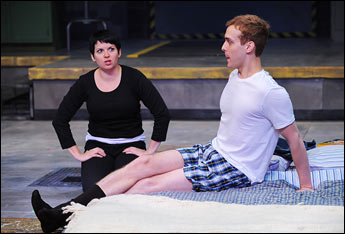 Conception and its unlikelihood being critical to the story at hand, Marshall’s narrator character (her name is Barbara, and she is singularly, strangely marvelous) gets a moment in the spotlight to spin a highly colorful tale about her own. It’s an anecdote, and an impulse, that make no sense at all in context, but that seem perfectly, whimsically wonderful once you realize that Boom’s larger concern is our twinned eternal hungers for hard historical facts and for holistic creation stories—for I-was-there scientific research and for deeper metaphors that help bind our data to our sense of self. That showstopper of a creation myth—Barbara admits, cheerfully, to embellishing it—comes packaged in language as grand and gaudy as anything King James’ scribes ever translated from the Vulgate, and it’s rather more joyful and exuberant besides. Good words, both, for Boom; its anxieties and its ambiguities and its accidents notwithstanding, this is one end-of-the-world story that’s likely to leave you grinning from ear to ear. DC
THEATRE SCENE . WASHINGTON'S
LIVELIEST THEATRE WEB SITE
Boom, a wickedly clever play set against a backdrop of mass extinction Boom I have some bad news for you. In the next few months, or years, life as we know it apparently will end, courtesy of a major collision between Earth and a great big comet. Regrettably, the few survivors will include, not an overweight, balding theater reviewer, but a nerdy fish scientist named Jules (Aubrey Deeker) and the hyperkinetic journalism student Jo (Kimberly Gilbert) who the fates have appointed as his partner in the arduous task of repopulating the world. I have learned about these unfortunate events from a museum exhibitor named Barbara (Sarah Marshall), who, being from the future, has a little perspective on them. I am happy to report that museum exhibitors from the future are just as pleasantly neurotic as they are today.
When the Boom arrives - and it arrives, believe me - it quickly becomes apparent how badly appointed Jules and Jo are for the task of repopulating humanity. In curiously modern ways - I won’t get into the details - their mating seems impossible, even unthinkable. The tiger and the naked mole rat, the shark and the damselfish in Jules’ tank, all mate without thinking, but Jules and Jo think without mating. Nachtrieb lays a provocative question on the table: in the event of a cataclysm, could we repopulate the world? Or have we become too particular; too quick to be repelled by the partner of less than our dreams, too offended by the thought of babies, with their demands and their spitup? Would we spend the remainder of our days curled up in the corner of our bomb shelters, listening to iTunes and wishing we could order pizza? That we are hearing the story from Barbara’s long-view perspective provides us with some comfort. Clearly someone survived, or we would not be watching this relentlessly didactic exhibitor, standing above the stage with her big drums and her light and sound system like an Olympian god in a Greek drama and giving us the exposition. That she mutters complaints about her employer, and that the mutterings become more pronounced and more detailed as the play goes on, comforts us further: things won’t get that much different, even across years of time. Olympian gods are in short supply, which should mean plenty of work for Sarah Marshall. In large part, the success of this play rises and falls on how well the actor who plays Barbara performs her role. She must begin by being intrusive without being obnoxious; at precisely the right moment she must shift the attention of the story from Jo and Jules to herself, and we must never resent her for it. Marshall is superb in all of this. Director Vreeke ratchets up the challenge for her by broadcasting an image of her face on the ceiling, so that the movement of every muscle is visible for us. It reminds us of the difference between theater and movie acting: stage actors act with their voices, and screen actors act with their faces. In Marshall, voice and face are in perfect harmony. I believe you could understand Barbara’s story simply by looking at her face, even if there was no dialogue; or from her voice alone. Deeker and Gilbert get less to work with from Nachtrieb, but they make the most of it. Jo is sort of a one-note character, but Gilbert manages to radiate her anger without making us angry with her. As for Deeker, he is able to capture the earnest awkwardness of the truly socially inept with great grace; at times, he is a Nijinsky of cluelessness. We manage not to laugh at him as he explains the bizarre deaths of the members of his immediate family. His one moment of real triumph - when he realizes that his prediction of mass extinction was correct - is, on the other hand, absolutely hilarious. A word about the set, which was designed by the celebrated architect Thomas Kamm: it is swell. I doubt that you have ever been in a graduate student’s underground bomb shelter lab/sleeping quarters - I know I haven’t - but the moment you take a look at what Kamm has put on the stage, you’ll know where you are. The rest of the technical work is done by the usual suspects: Colin K. Bills on lighting; Neil McFadden on sound; and Ivania Stark doing costumes, and it is all unobtrusively effective. Woolly Mammoth
641 D Street, NW (7th & D) Washington, DC 20004 
Nearby landmarks:Woolly Mammoth is located in the bustling Penn Quarter neighborhood on D street between between Oyamel & Rasika restaurants, around the corner from TicketPlace and down the street from Shakespeare Theatre Company's Lansburgh theatre. We are two blocks north of the National Archives and National Gallery of Art and 2 blocks south of the Verizon Center (formerly the MCI Center) and the Smithsonian American Art Museum/Portrait Gallery. MetroArchives-Navy Memorial-Penn Quarter (Yellow & Green lines)
— 1 block away MetrobusThe 70, 71, D1, D3, and D6 buses stop at the corner of 7th
& E. |
 Jules is a lonely marine biology grad student who's just
placed a racy personal ad online; Jo is the randy journalism major
who's answered the call. Yet Jules is oddly reluctant, and the offbeat,
high-strung Jo keeps passing out as she tries to leave his strange
biology lab-cum-dorm room.
Jules is a lonely marine biology grad student who's just
placed a racy personal ad online; Jo is the randy journalism major
who's answered the call. Yet Jules is oddly reluctant, and the offbeat,
high-strung Jo keeps passing out as she tries to leave his strange
biology lab-cum-dorm room.
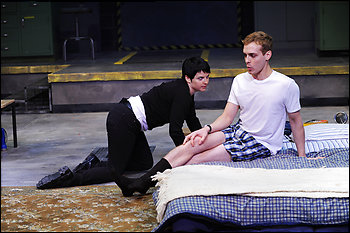 Gilbert, meanwhile,
is a terror as Jo, who sours quickly once she realizes she won't get
the hot evening she came for. Jo has an appealing ferocity that
eventually has shades of Linda Hamilton in "Terminator 2," even with
those pesky sudden blackouts. (Along with everything else, that
eventually gets explained in Nachtrieb's crazy-logical script.)
Gilbert, like Deeker, not only nails the quirky lines, but also leaps
boldly into Vreeke's escalating physical staging as Barbara's role
begins to make sense and "Boom's" cosmic take on beginnings and endings
rounds into view.
Gilbert, meanwhile,
is a terror as Jo, who sours quickly once she realizes she won't get
the hot evening she came for. Jo has an appealing ferocity that
eventually has shades of Linda Hamilton in "Terminator 2," even with
those pesky sudden blackouts. (Along with everything else, that
eventually gets explained in Nachtrieb's crazy-logical script.)
Gilbert, like Deeker, not only nails the quirky lines, but also leaps
boldly into Vreeke's escalating physical staging as Barbara's role
begins to make sense and "Boom's" cosmic take on beginnings and endings
rounds into view. 
 Boom, a
wickedly clever play set against a backdrop of mass extinction is,
curiously enough, a comedy: a story about
birth, and about the persistence of life. Jules lures Jo into the
refurbished bomb shelter that is both his lab and his home with a
Craigslist ad which promises “intensely significant coupling”. In the
sense Jules means it, all coupling which includes the possibility of
birth is intensely significant. The child who results may lead nations,
or discover the unified field theory, or start a savage war. Or
repopulate the world after a cataclysmic event. Jo is after something
different: a random orgasm which might give meaning to her arid life.
Jo and Jules learn this thing with the audience over the course of the
play: it is hard to have a significant experience.
Boom, a
wickedly clever play set against a backdrop of mass extinction is,
curiously enough, a comedy: a story about
birth, and about the persistence of life. Jules lures Jo into the
refurbished bomb shelter that is both his lab and his home with a
Craigslist ad which promises “intensely significant coupling”. In the
sense Jules means it, all coupling which includes the possibility of
birth is intensely significant. The child who results may lead nations,
or discover the unified field theory, or start a savage war. Or
repopulate the world after a cataclysmic event. Jo is after something
different: a random orgasm which might give meaning to her arid life.
Jo and Jules learn this thing with the audience over the course of the
play: it is hard to have a significant experience.